
What the Heck Is De-Extinction? The Case for (and Against) Playing God
Inside the bold world of resurrecting extinct species...

I came across the names Romulus, Remus, and Khaleesi in a headline that sounded too strange to be real.
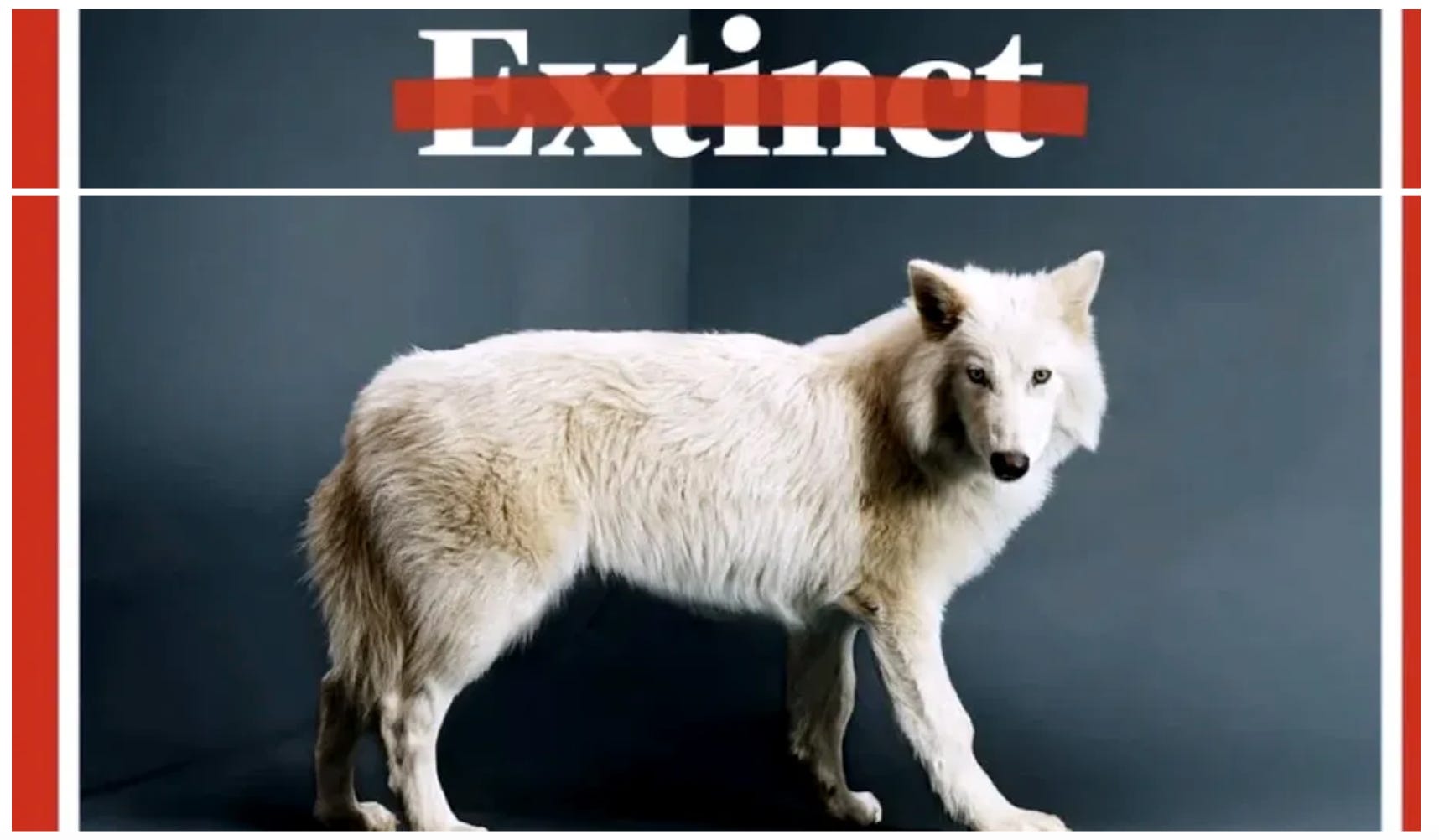
Three wolf pups, engineered from gray-wolf DNA, carrying traits of the long-extinct dire wolf - yes, the ones from Game of Thrones.
They were born on a private ranch somewhere in the northern United States — bigger, paler, denser-coated than any living wolves. The announcement was framed as a triumph of science.
What intrigued me wasn’t just the headline, but the idea itself — what does it really mean to bring back an extinct species? To say we’ve pulled a whole lineage out of extinction?
Before we go further, it’s worth untangling the semantics — because some of the debate around “de-extinction” is really a debate about definitions.
So what is De-Extinction?
A quick Google trend search shows rising interest in De-Extinction since 2013, when scientists started publicly debating whether extinct species like the Woolly Mammoth could ever walk again. Interest surged again this year — thanks to those three wolf pups.
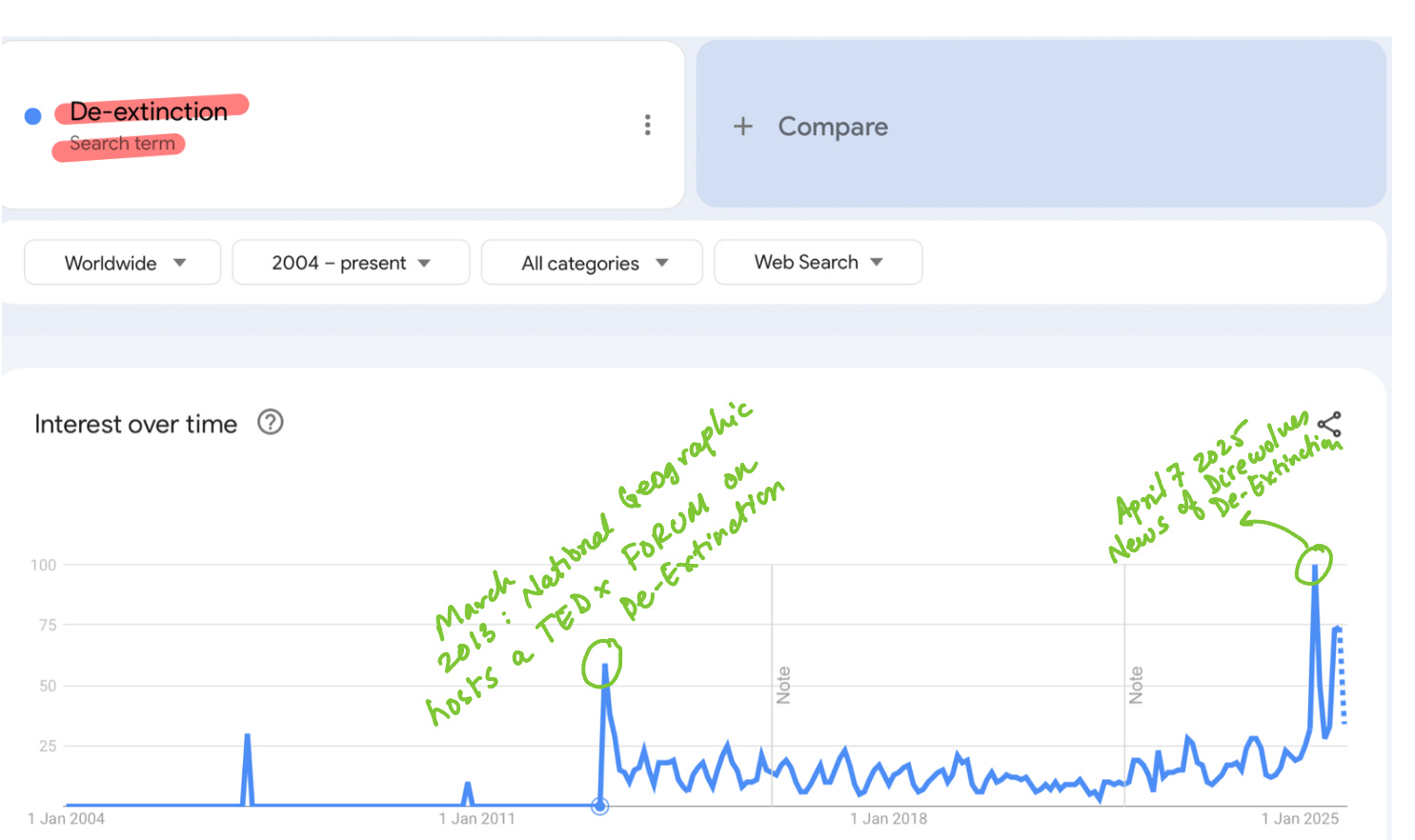
The first spike in March, 2013 coincided with a National Geographic Forum called TEDxDeExtinction and several news outlet started reporting the potential to bring the Woolly Mammoth back from the dead. And more recently, it was the birth of the direwolves that had everyone (especially me) googling the term in April of this year!
The consensus definition based on literature is “De-extinction is the process of creating an organism which is – or greatly resembles – a member of an extinct species”.
There are three ideas packed into that definition worth pausing on: “creating an organism”, “which is or greatly resembles” and “a member of an extinct species”.
So, what exactly is a “Species”?
It’s a classification tool invented by humans, and there are several ways you can cut and slice the billions of animals, plants, and microbes that inhabit the earth.
Biologists use one test—if two organisms can mate and produce fertile offspring, they’re the same species (Biological Species Concept).
Paleontologists use another, because they can’t exactly breed fossils; they rely on morphology — shape, size, structure (Morphological Species Concept).
Geneticists prefer sequence data (Genetic Species Concept).
Each approach has its blind spots, and depending on which one you favor, the same animal could be classified three different ways. Ultimately, there are many ways to identify a “Species” with researchers using one or a combination of these concepts to classify existing and sometimes convince others that they have found a new species.
A unique discussion in the De-Extinction debate is whether you are truly bringing back the “OG dire wolf” back to life or whether you just have a “modified wolf”.
In practice, the argument over whether Romulus, Remus, and Khaleesi are “true” dire wolves or just modified gray wolves is mostly semantic. From a morphological standpoint — the standard used for extinct species — they fit the bill. From a genetic or biological one, maybe not. But in either case, we’ve built something that doesn’t fully resemble anything alive today.
Irrespective of which classification lens you prefer, one thing is clear: we used ancient genetic information to create an organism that may not be 100% identical to its ancestors, nor is it to anything alive today. At the very least, we’ve created a new species.
We didn’t clone something that already exists — we made something that hasn’t existed before.
In plain terms, you can argue, we created a new species.
A new species!
Let that sink in.

Once you realize we’ve crossed from cloning into creation, the next question is: who’s behind it all — and what kind of science makes it possible? Or, to borrow from Game of Thrones, who’s the Daenerys to these dragons?
The answer leads to Dallas, Texas — and to a company called Colossal Biosciences.
Founded in 2021, Colossal brands itself as “the de-extinction company” and has announced plans to bring back Woolly Mammoths, Dodos, and Tasmanian Tigers, some of the biggest stars in the species extinction hall of fame. On a planet with as many as one million species at risk of disappearing, many within decades, the company is promising an undo button.
The company has raised $555 million to date, with a valuation of a touch over $10 billion. The cap table includes celebrities like Tom Brady, Paris Hilton, Tiger Woods, Tony Robbins, Chris Hemsworth, and Peter Jackson. But outside of the celebrities, Colossal Biosciences is associated with highly credible and decorated scientists, most notably its co-founder and lead geneticist, George Church of Harvard Medical School. While the company does receive funding and publicity from celebrities, its scientific team is composed of respected researchers and experts in genetic engineering and conservation.
Just how Colossal accomplishes this task of de-extinction traces back to the origins of modern genetics itself. Ever since Watson, Crick, Franklin, and Wilkins mapped the double helix in 1953, biology has slowly revealed itself as a form of code — programmable, editable, and now, increasingly, designable. The discovery that DNA carries all the instructions for building life launched what’s often called the biorevolution: the recognition that if life runs on code, then — at least in theory — it can be edited, rewritten, and created — just like you would code a software program.
For the dire-wolf project, the de-extinction process began when researchers extracted fragments of ancient DNA from fossils — one a 13,000-year-old tooth from Ohio, another a 72,000-year-old skull from Idaho.
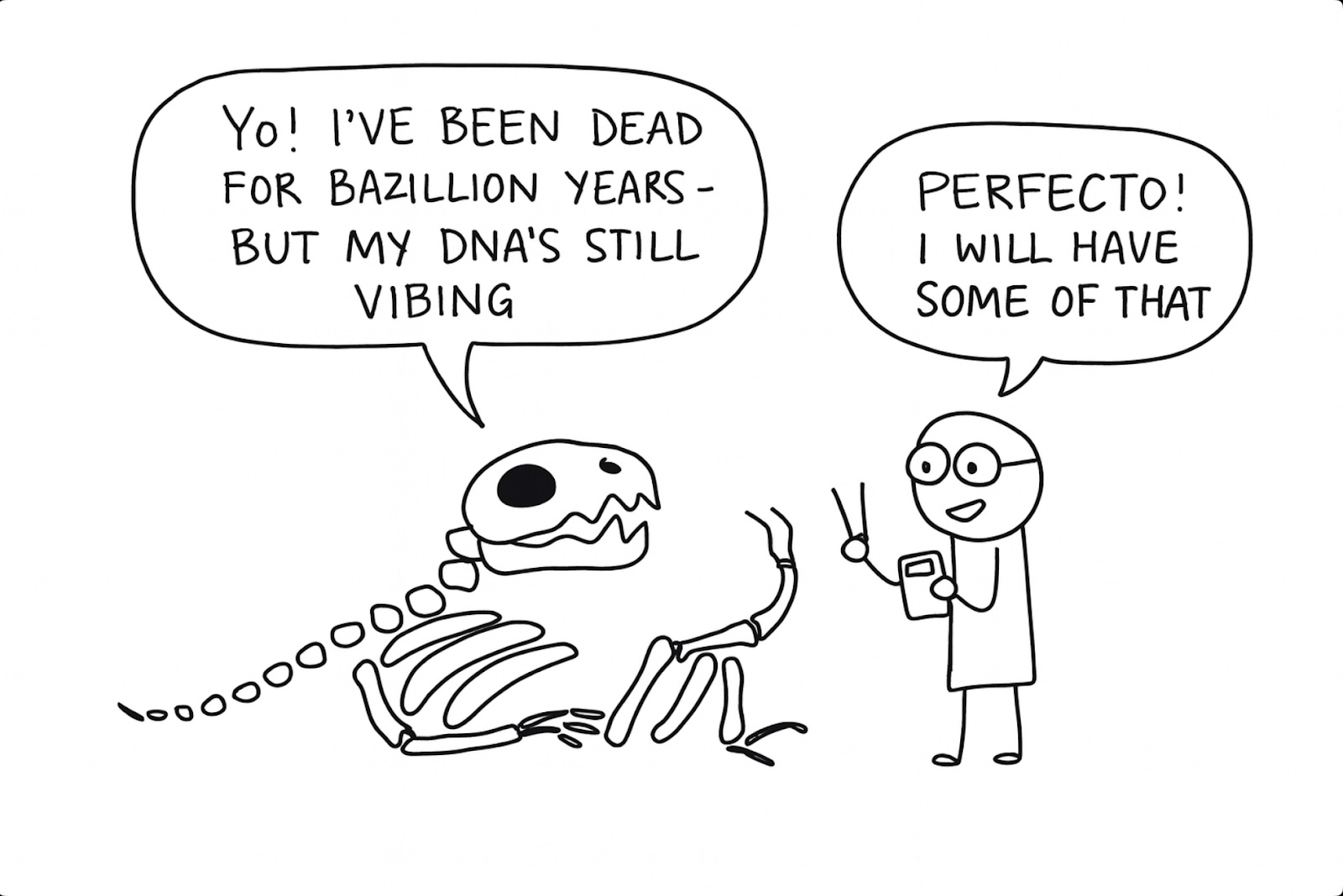
Advances in genome sequencing over the past decade made it possible to reconstruct those fragments into near-complete genomes and compare them against the gray wolf. From that comparison came a shortlist: twenty key genes that shaped the dire wolf’s size, coat, and physiology.
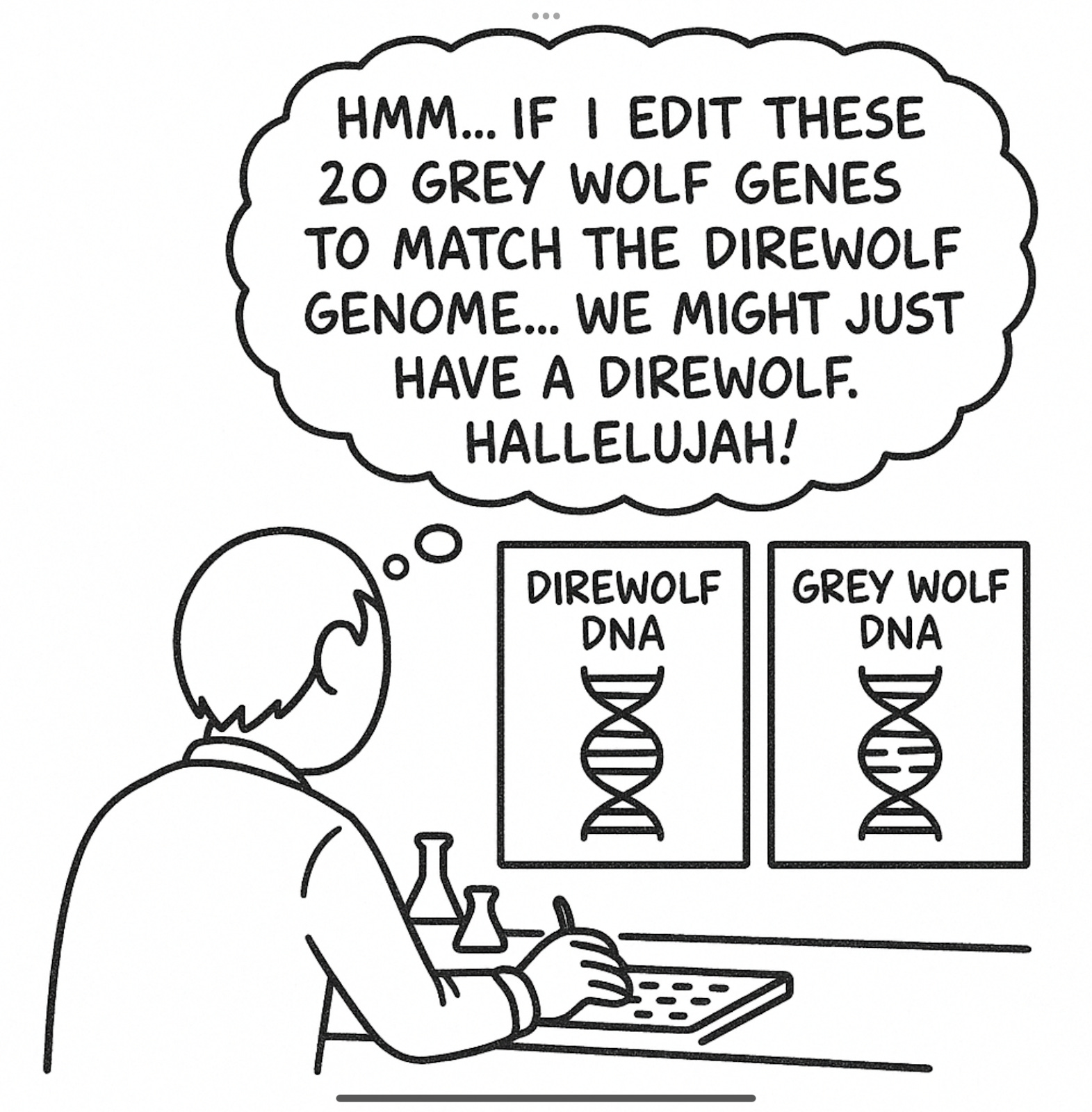
The next tool in the toolkit is CRISPR, the molecular “scissors” that allows scientists to cut and replace precise snippets of DNA (here is a refresher on CRISPR). Using CRISPR, Colossal scientists introduced those mutations into cultured gray-wolf cells, tweaking twenty* genes directly.
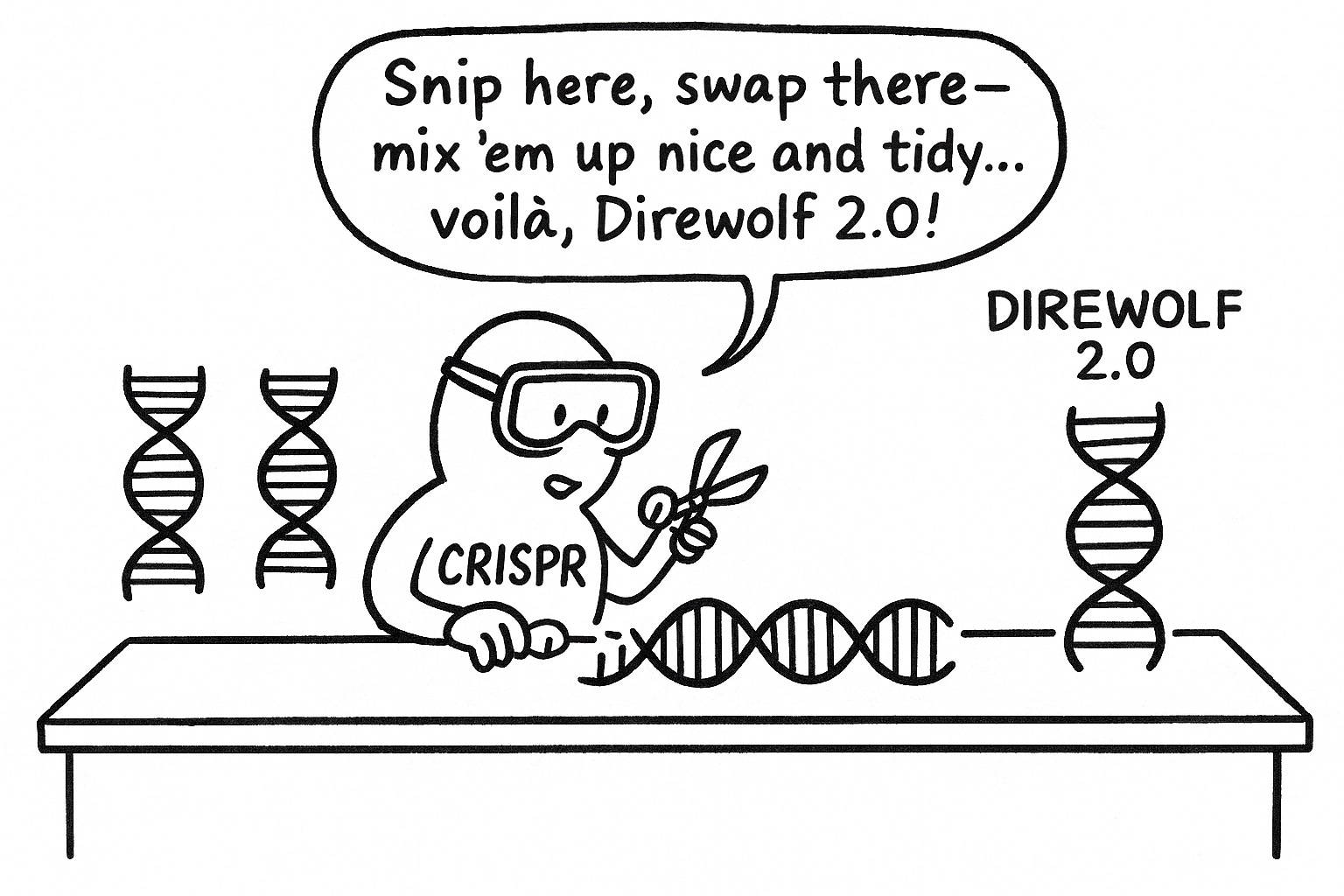
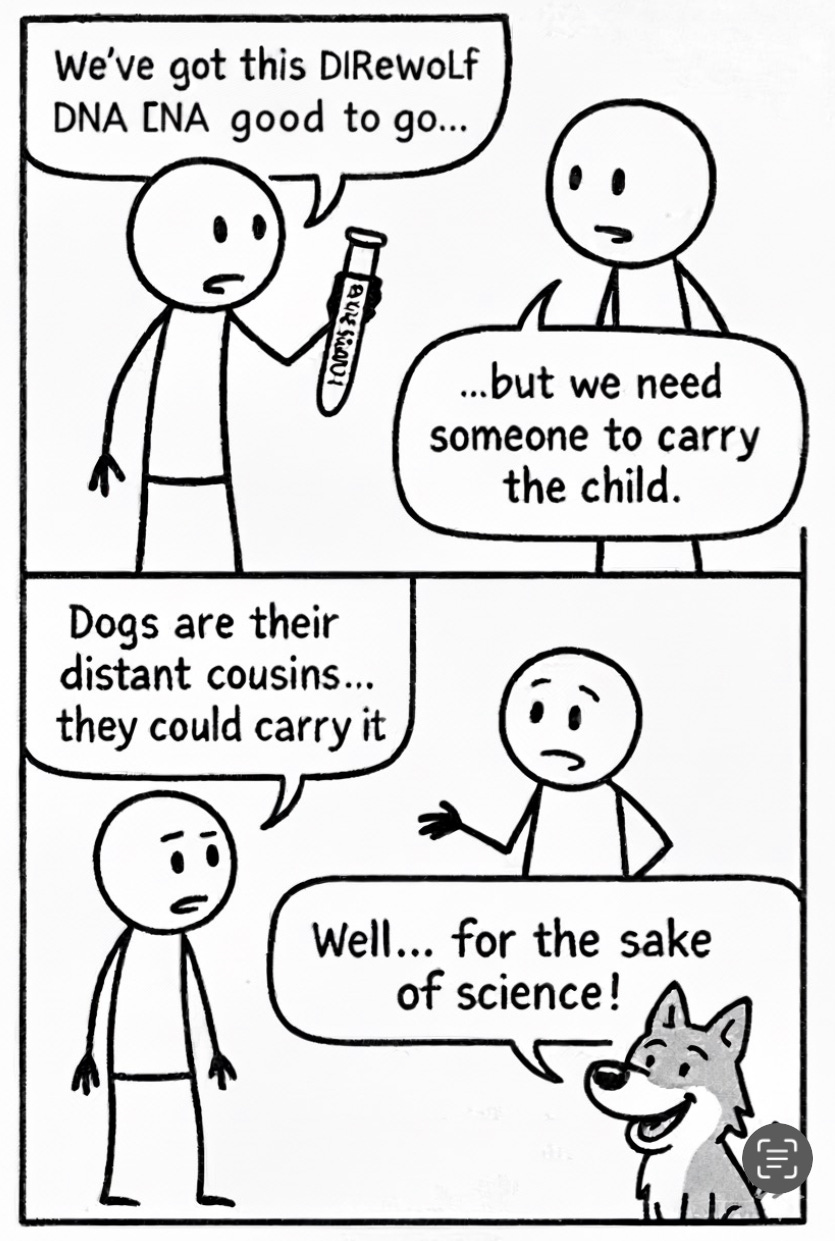
Once the DIREWOLF 2.0 DNA was ready, the scientists had to find a carrier!
Once the gene edits and carrier selection were complete, the team used Somatic Cell Nucleus Transfer (SCNT) to insert the modified nuclei into dog eggs. SCNT is the same cloning process used to create Dolly the sheep in the 1990s. In SCNT, scientists remove the nucleus from an egg cell and replace it with the nucleus from a genetically edited cell, effectively reprogramming the egg to grow into an organism that carries the new CRISPR-edited DNA.
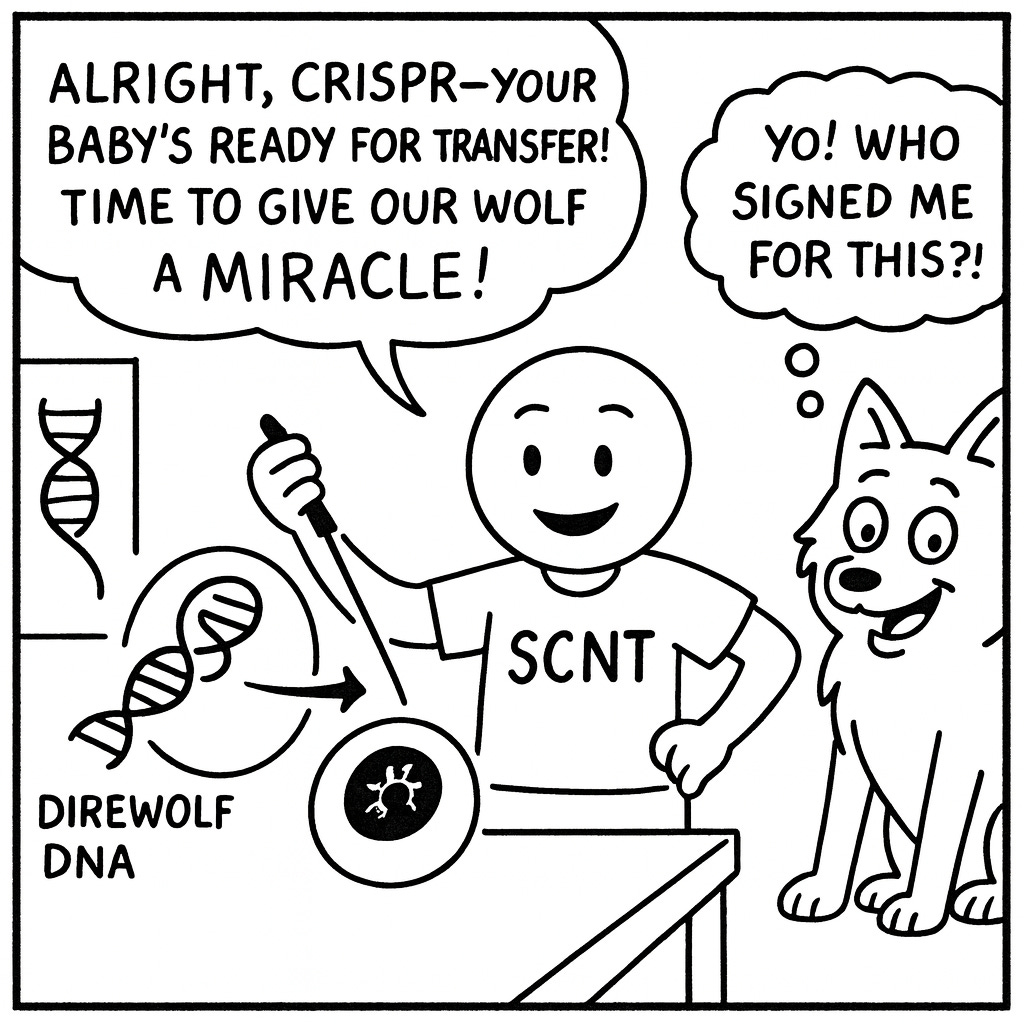
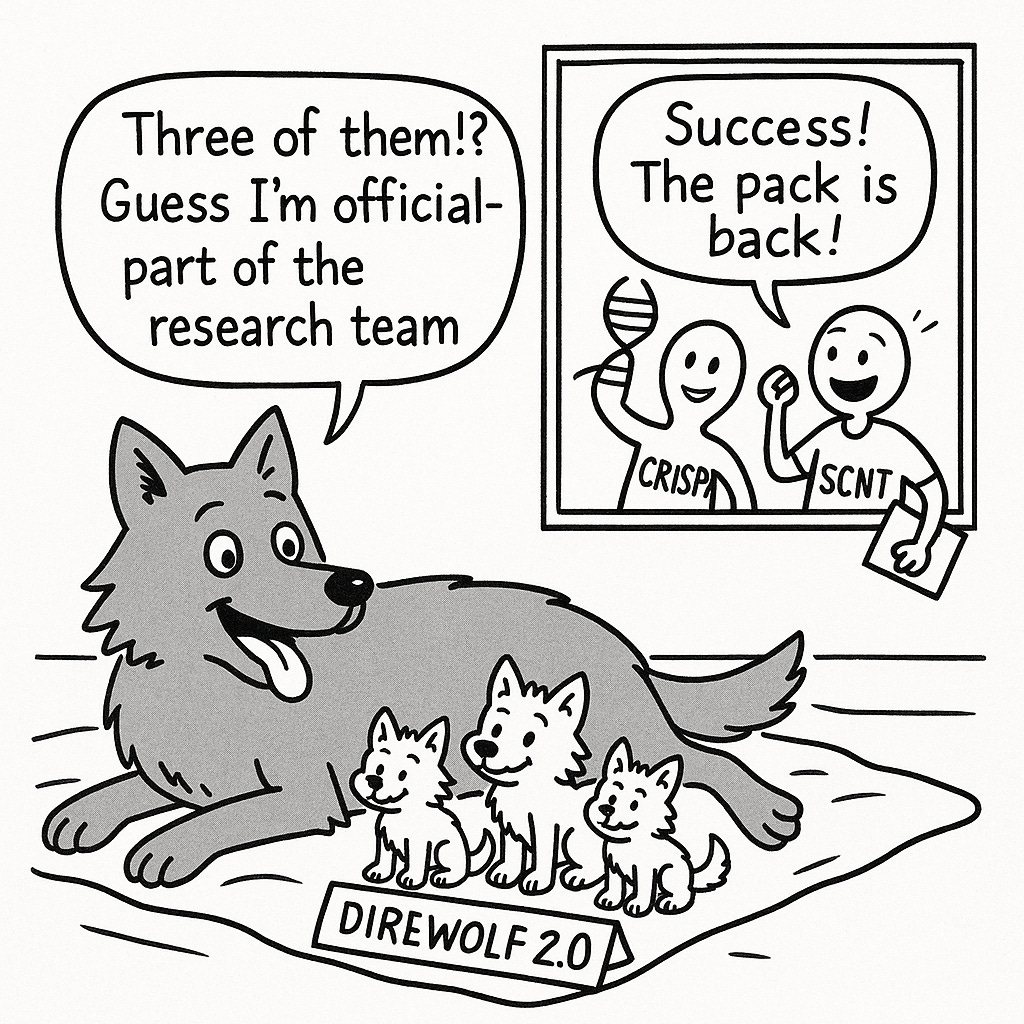
After implanting the resulting embryos in surrogate dogs, the scientists waited. Most failed to develop. Four pups were born. Three survived. Two males and one female — Romulus, Remus, and Khaleesi.
The beauty of the process lies less in any single step than in what it represents: the convergence of genome sequencing, CRISPR precision, and cloning reliability into a single repeatable pipeline. That pipeline is now being applied far beyond wolves—to Dodos, Mammoths, and Tasmanian Tigers, each a new experiment in translating ancient code back into living form.
The science is astonishing — no question there. But it also leaves us standing at a strange new edge. For the first time, extinction itself feels optional, and that thought lands somewhere between thrilling and unsettling. If we can now edit, clone, and recreate life, the next question isn’t about how far the technology can go, but whether it should.
Or, as Dr. Ian Malcolm put it in Jurassic Park:
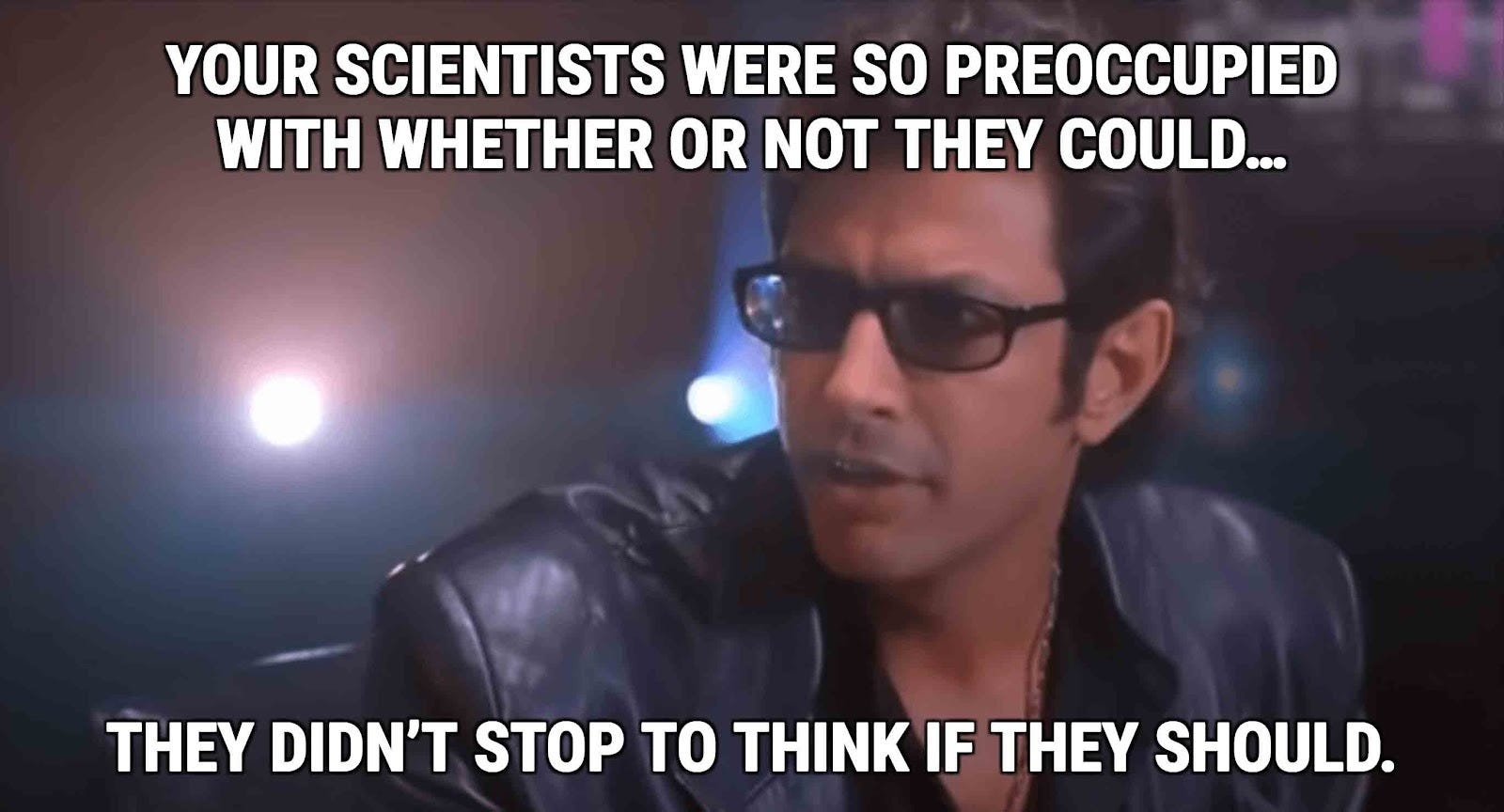
That single question — should we? — has followed every discussion of de-extinction since the idea first left the pages of science fiction.
This is the question I’m still wrestling with. I’ve read articles, watched debates, and found that most arguments for and against de-extinction fall into a few clear buckets.
Ethics & Welfare
Do we have a moral obligation to bring back species that vanished because of us — the Dodo, for instance, hunted into oblivion by humans?
It’s a common argument, but to me, it is the weakest one. Moral debt does not scale well across centuries or millennia. Do we, today, inherit the sins of everyone who came before us? If correcting past wrongs justifies creating new life, where does that logic end? Would we then apply it to humans—rebuilding erased lineages and restoring lost generations from world wars and other past conflicts?
It’s a slippery slope, and one that shifts the debate away from science and toward emotional sentiment.
Species Health
Then there’s the question of whether what we attempt to bring back can actually survive. In 2003, scientists attempted to clone the Pyrenean ibex using cells from the last known individual of the species. They created 208 embryos, implanted them into 57 surrogates, and got one live birth — a clone that died within minutes from lung failure. The Ibex went extinct twice.
Biological science has advanced dramatically since then. CRISPR didn’t even exist when that experiment was run, and the fact that Colossal’s dire wolves are currently healthy so far is a sign of how far the technology has come.
However, there’s also the “first generation dilemma”. Romulus, Remus, and Khaleesi are genetically edited gray wolves born to surrogate dogs. Without ancestral packs or learned behaviors, we must ask: what does it truly mean for them to be “dire wolves”? Animals learn vital skills from their kind — how to hunt, play, and survive. Without a pack to learn from, do these Dire Wolves ever acquire the social traits of a Dire Wolf?
Conservation
Another criticism is that de-extinction may distract from current conservation efforts, from protecting what’s endangered now.
Critics argue that money spent reviving mammoths would be better used for saving living species like rhinos. However, Colossal contends that the gene-editing technologies for de-extinction can also aid in preserving existing species. If evolution can’t keep pace with climate change, maybe we can give evolution a nudge. In other words, Colossal isn’t just undoing the past; it’s trying to accelerate the future.
Still, conservation is about tradeoffs. Every dollar spent reviving a mammoth is a dollar not spent saving a species that’s actually here. The question isn’t whether de-extinction can work — it’s whether it’s the best use of scarce attention, money, and moral capital.
Ecological Role & Climate
Some argue that de-extinction could restore damaged ecosystems. Apex predators like the Tasmanian Tiger might help rebalance overgrown prey populations. But restoring a species isn’t the same as restoring an ecosystem. It’s one thing to recreate a body; it’s another to rebuild the natural web it belonged to.
The argument for ecological restoration presents a circular logic problem. Many extinct species lost their habitats first, which led to their disappearance. So, where exactly do you put them if their original habitat no longer exists? Are they meant to roam free, or just live out their days as curiosities in a lab or zoo? At some point, doesn’t this start to resemble less of a genuine restoration and more like Jurassic Park?
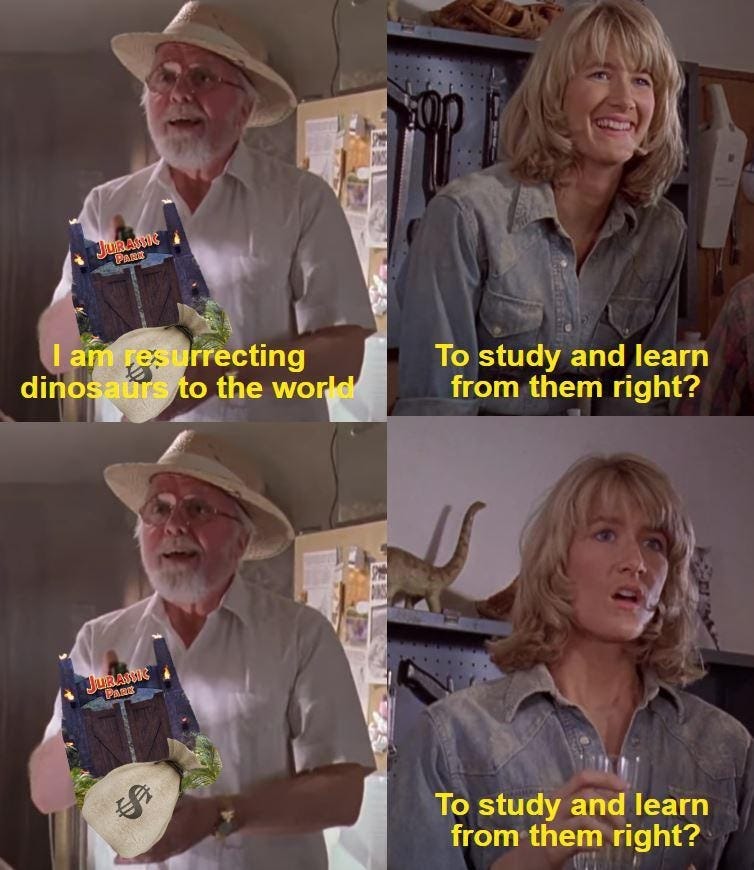
Colossal insists it’s not a Jurassic Park vanity project but a genuine scientific moonshot.
The company likes to compare its work to the space race — a seemingly impossible pursuit that generated collateral inventions that we still use today. Already, Colossal has spun out a plastic-degradation startup, a software venture that raised $40 million, and another called Astromech, focused on using AI and robotics to study genetic resilience — including why some species are more cancer-resistant than others. The science, even when tangential, is fertile.
So should we bring animals (or even plants) back from extinction?
I think it has to be a case-by-case decision. Species that disappeared in recent years, decades, or even centuries might still offer genuine ecological benefits if reintroduced. If your goals are purely conservation-driven, you’d start there — with the recently lost. Why the woolly mammoth?
Even then, can we realistically bring back enough of any species to restore an ecosystem? Can they be safely reintroduced without disrupting the ones that replaced them? Ecology isn’t static — it evolves. After decades or millennia of absence, it’s far from certain that a reintroduction would even be “good” for the system it’s meant to heal.
With my limited expertise, I’d say the ecological restoration argument stands on shaky ground. De-extinction should be evaluated species-by-species, weighing not just the technical feasibility but the downstream effects — intended or otherwise — of setting something long gone back into motion.
The reason I can still get behind Colossal is the potential for side discoveries.
If the real goal is science that spills over into important collateral discoveries/inventions, then perhaps it’s worth aiming for the most complex challenge — the woolly mammoth moonshot.
But that also raises a harder question: when do we decide that these side-discoveries are “enough”? Does success with one species justify trying the next, and the next after that? And then do we risk chasing creation for its own sake?
Maybe the real value of de-extinction won’t be in the species it brings back, but in what we learn along the way — about genetics, ecosystems, and the boundaries of human ambition.
Every failed experiment may sharpen the tools we use to protect what’s left. And every success may force us to ask harder questions about where science should stop.
If the twentieth century was about understanding life, the twenty-first might be about editing it. Whether that becomes our greatest achievement or our greatest mistake will depend not on what we can do next, but on when we decide that we’ve done enough.
Such a good read Tambi!